

What CMS Is Actually Doing With RPM And APCM

Summary & Key Insights

Originally published at: https://fairpath.ai/resources/cms-rpm-apcm-2025-26

If you run an independent practice, there is a good chance remote patient monitoring is a sore subject.

You might hear the term “RPM” and immediately think of a vendor that overwhelmed your staff with devices, made big promises, and left you with documentation that never felt stable once audits became real. They left you with messy documentation and a billing setup that never felt like it would survive a serious review.

During COVID, RPM was marketed as the lifeline that would keep the doors open. In reality, for many practices, it became a source of anxiety that has not fully gone away. It is understandable that a lot of physicians and practice leaders have mentally put RPM into the “failed experiment” bucket.

The problem is that this is not actually how CMS is treating these programs.

CMS Still Sees Value in Remote Monitoring

If CMS believed RPM was a mistake, it could have quietly starved it of oxygen. That is not what happened.

RPM survived the pandemic and was refined. The codes stayed in the Physician Fee Schedule. The rules were adjusted. New flexibilities were introduced alongside new scrutiny. All of that signals something important: CMS still sees real clinical and financial value in remote monitoring. The agency simply wants that value delivered in a more disciplined, predictable way.

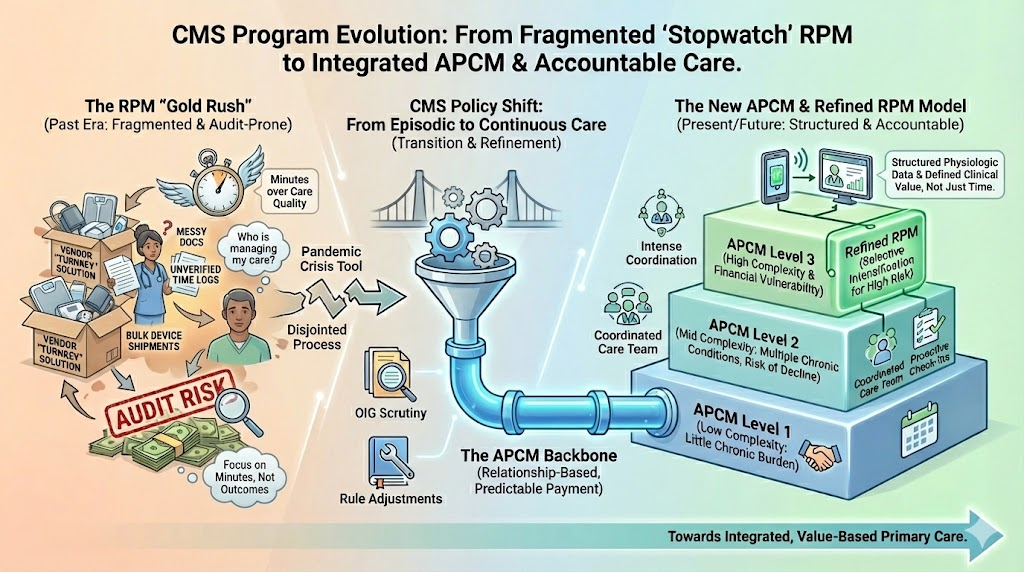
Underneath the audits and enforcement activity there is a bigger policy shift. CMS is trying to move primary care away from purely episodic visits and toward relationship-based, continuous care. The long-term goal is simple: more patients in accountable care arrangements, fewer patients in a fragmented, visit-only model.

This is the context for the new Advanced Primary Care Management (APCM) benefit. If you want the code-level, practice-facing details, we’ve put them in a full guide on FairPath: What CMS’ 2025–26 Rule Changes Mean for RPM & APCM (and How to Run Them In-House).

What Went Wrong During the Pandemic

When the pandemic hit, RPM went from an interesting idea to a crisis tool almost overnight. Practices were locked down. Patients were at home. Fee-for-service revenue was evaporating. Third-party vendors moved quickly with turnkey offers and aggressive projections. Many practices, quite reasonably, focused on survival rather than on designing a long-term care model.

In that environment:

  • Panels were sometimes built around whoever would answer the phone instead of around clinical risk.
  • Time tracking and documentation were often treated as something the vendor would “handle,” instead of as a core compliance responsibility for the practice.
  • Internal governance was thin because everyone was exhausted and just trying to get through the year.

Fast forward a few years and OIG is now doing exactly what you would expect. They are asking how many patients were enrolled, what work was actually done, and whether the documentation supports what was billed. For some practices the answer is clean. For others, the records tell a more complicated story.

If you read between the lines of recent rule-making and OIG reports, a clear narrative emerges: the government is tired of paying for device mills.

The Pivot to APCM: From Device Mills to Continuous Management

For the past five years, much of the RPM industry has been dominated by a specific type of vendor: one that ships thousands of Bluetooth blood pressure cuffs, collects 40–60% of the practice’s revenue, and generates reams of PDF reports that often sit unread in a portal.

OIG has noticed. Their work highlights waste in “device-only” billing and a lack of care coordination. CMS’ answer is not to kill remote care; it’s to redesign how it’s paid for.

That redesign is APCM.

APCM is not a niche experiment. It is CMS taking years of lessons from CCM, care-management demonstrations, and remote-technology codes and wrapping them into a monthly payment for the real work primary care teams do between visits.

The important detail is that APCM is structured as three levels that map to patient complexity, not to how many minutes someone spent on a timer or how many times a patient stepped on a scale.

  • The lowest level is the Medicare patient with little or no chronic disease burden.
  • The middle level is the patient with multiple chronic conditions who is at genuine risk of decompensation or hospitalization if the practice does not keep a steady hand on their care.
  • The highest level is the patient who is both clinically complex and financially vulnerable.

Each level carries a different payment amount, but the underlying idea is the same:

primary care teams are doing meaningful coordination work and CMS is willing to pay a predictable, per-member amount for that work.

Notice what is absent from that description:

  • No requirement that a nurse hit a precise 20- or 30-minute threshold on a stopwatch every month.
  • No requirement that every eligible patient has to be wearing a device.

There is still a clear expectation that defined service elements are delivered and documented. There is still an expectation that patients have access and support between visits. But the emphasis has shifted from timer management to team-based, relationship-centered care.

That shift makes the old outsourced RPM model much harder to justify.

APCM is designed to be run by the practice, not by a call center. It rewards 24/7 access, comprehensive care planning, and continuity—things an outsourced vendor cannot genuinely provide.

A New Mental Model: APCM as the Base, RPM as Intensification

This creates a different mental model for operations.

In the older view, you were either “doing RPM” or you were not. You either had a chronic care management vendor or you did not. Each program sat off to the side of your core clinic operations and had to justify itself on its own. Remote care was a bolt-on product line.

APCM pulls those activities back toward the center. It says, in effect, that a primary care panel can be treated as a managed population. Many Medicare patients can be inside some version of a structured, between-visit care model where the practice is paid to keep an eye on them, adjust plans, coordinate with specialists, and intervene before a crisis.

Once you see APCM that way, RPM looks different too:

  • RPM stops being a standalone “business line.”
  • It becomes a selective intensification of care for the patients who truly need it.

An APCM-enrolled patient with stable chronic conditions might never need a device. Another patient with brittle heart failure or complex hypertension might clearly benefit from structured device-based monitoring layered on top of their APCM relationship.

In that world, the real work is not “sign up as many patients as possible for RPM.” The real work is designing a coherent panel strategy:

  1. Which Medicare patients fit your APCM framework, and at what level.
  2. Which APCM patients truly justify the added complexity of RPM.
  3. How you will govern and audit the whole arrangement.

Any practice that offers RPM and care management without a written set of eligibility criteria, workflows, and spot checks is taking unnecessary risk. After the last few years, a modern remote-care program should have the same level of internal oversight as a high-risk in-office procedure.

Why We Think the Future Is Vendor-Free

Put these pieces together and the picture looks very different from the “RPM gold rush” days.

CMS is still paying for remote monitoring. In some ways it is paying more flexibly than before. At the same time, it has built APCM as a new backbone payment that can cover almost an entire Medicare panel at different levels of complexity. The audits and the new program design are two sides of the same coin.

The message is not “stop doing remote care.” The message is closer to:

“Use remote care in a structured, accountable, primary-care-first way,  and stop outsourcing your audit risk.”

We believe the future of remote care is vendor-free:

  • Practices should use software to automate logistics and compliance checks.
  • Practices should own the clinical relationship and the revenue.
  • Vendors who take 40–60% of your RPM check for running a call center don’t fit where CMS is going.

Get the Full, Practice-Facing Breakdown

This post is the strategic view. If you’re a physician, medical director, or practice manager and you want the practical, practice-facing details, we put them in a full guide on FairPath:

👉 What CMS’ 2025–26 Rule Changes Mean for RPM & APCM (and How to Run Them In-House)

That guide covers:

  • A line-by-line comparison of vendor-based RPM vs in-house APCM/RPM economics.
  • A check-list for 2025–2026 OIG/RPM audit readiness.
  • How to design an “APCM-First” panel strategy where RPM is used only when it clearly changes care.
  • How to structure a vendor-free remote care program so your team stays in control.

Want to See Actual Numbers for Your Panel?

If you want to see what an APCM-first, vendor-free model looks like in dollars for your specific panel size, we’ve also published a simple calculator on FairPath:

👉 Run the Reimbursement Calculator(See what APCM + in-house RPM could generate — without rev-share.)

Read More

Red Alert: UnitedHealthcare Restricting RPM Coverage to Heart Failure & Pregnancy (Effective Jan 1, 2026)

12/3/25

If you are billing RPM for Diabetes, Hypertension, or COPD under UHC, your claims will likely be denied starting January 1st.

If UnitedHealthcare (UHC) is a significant payer for your practice, you need to audit your Remote Patient Monitoring (RPM) panel immediately....

Read more

The Hidden Pressure No One Talks About in RPM: What Happens at 18 Minutes

11/25/25

Most independent practices didn’t launch remote care programs so they could track timers, chase scattered documentation, or argue with spreadsheets at the end of every month. They adopted RPM and CCM because they believed these programs would keep patients out of the hospital...

Read more

Inside the Remote Care Collapse — and the Path to Recovery

11/4/25

Over the past several years, I’ve heard it all.
Remote patient care is a scam. It doesn’t work. RPM is designed to fail.
I’ve listened to the frustrations from doctors, managers, and administrators who swear that remote care is nothing but another profit scheme wrapped in good intentions...

Read more

The 8% Problem: Why State-of-the-Art LLMs Are Useless for High-Stakes Precision Tasks

10/30/25

In the race to solve complex problems with AI, the default strategy has become brute force: bigger models, more data, larger context windows. We put that assumption to the ultimate test on a critical healthcare task, and the results didn’t just challenge the “bigger is better” mantra; they shattered it...

Read more

CMS’s 2026 Updates Signal a New Era for In-House Remote Care Coordination

10/21/25

Healthcare is on the brink of a fundamental shift. The forthcoming 2026 CMS Physician Fee Schedule updates are far more significant than mere billing adjustments, they signal a new era in remote care coordination. Practices that adapt early will not only enhance patient care but also secure long-term operational advantages...

Read more

CMS Brings Behavioral Health into the APCM Model: What It Means for Primary Care

10/9/25

CMS is quietly reshaping how primary care teams can be paid for mental and emotional health support. Starting in 2026 (if finalized), practices using the new Advanced Primary Care Management (APCM) codes will be able to add small, monthly payments for behavioral health integration...

Read more

Stop Choosing Between APCM and Your RPM/RTM Revenue

10/7/25

If your practice adopted APCM by shutting down RPM and RTM programs, you left money on the table. If you're running all three programs separately, you're burning cash on duplicate documentation and exposing yourself to compliance risk...

Read more

APCM vs. CCM Explained: Medicare’s 2025 Coding Shift Every Primary Care Leader Must Understand

10/1/25

On January 1, CMS introduced a brand-new benefit called Advanced Primary Care Management (APCM), a monthly payment designed to roll up the core elements of care coordination under a single code. For primary care leaders, this changes the landscape in profound ways. APCM overlaps with Chronic Care Management (CCM)...

Read more

Neurosymbolic Ontologies with Buffaly

9/24/25

This document outlines a groundbreaking proof of concept for reimagining medical ontologies and artificial intelligence. Buffaly demonstrates how large language models (LLMs) can unexpectedly enable symbolic methods to reach unprecedented levels of effectiveness. This fusion delivers the best of both worlds: completely transparent, "white box" systems capable of autonomous learning directly from raw data...

Read more

APCM and the “Coordination of Care Transitions” Requirement: How To Get It Right

9/23/25

Advanced Primary Care Management (APCM) represents one of the more meaningful changes in the CMS Physician Fee Schedule. As of January 1, 2025, practices that adopt this model will be reimbursed through monthly, risk-stratified codes rather than only episodic, time-based billing...

Read more

APCM, Explained: What It Is, Why It Matters, What Patients Gain

9/18/25

Primary care is carrying more risk, more responsibility, and more expectation than ever. The opportunity is that we finally have a model that pays for the work most teams already do between visits. The risk is jumping into tooling and tactics before we agree on the basics....

Read more

Noncompete Clauses In Healthcare: The FTC Warning, APCM Staffing, And Platform Partnerships

9/16/25

The Federal Trade Commission’s Sept. 12 warning to healthcare employers is a simple message with real operational consequences. Overbroad noncompetes, no‑poach language, and “de facto” restraints chill worker mobility and can limit patients’ ability to choose their clinicians. For practices building Advanced Primary Care Management teams, restrictive templates do more than create legal risk...

Read more

The APCM Quick Start Guide: Converting Medicare's Complex Care Program Into Practice Growth

9/9/25

Advanced Primary Care Management represents Medicare's most ambitious attempt to transform primary care economics. Unlike previous programs that nibbled at the margins, APCM fundamentally restructures how practices organize, deliver, and bill for comprehensive care...

Read more

13 Things You Need To Implement Advanced Primary Care Management (APCM)

9/5/25

Advanced Primary Care Management (APCM) is Medicare’s newest program, introduced in 2025 with three billing codes: G0556, G0557, and G0558. This represents a pivotal shift toward value-based primary care by offering monthly reimbursements for delivering continuous, patient-focused services. You're already providing these services—why not get paid for it?

Read more

When Women's Health Can't Wait: How Remote Care Creates Presence in Life's Most Critical Moments

8/26/25

At 2 AM, a new mother in rural Alabama feels her heart racing. She's two weeks postpartum, alone with a newborn while her husband works the night shift. Her blood pressure reading on the home monitor shows 158/95. Within minutes, her care team receives an alert. By 6 AM, a nurse has called, medications are adjusted, and what could have been a stroke becomes a story of crisis averted.

Read more

Medical Remote Care: How Vendor Models Shift Margin and When to Bring RPM In-House

8/18/25

Many health systems pay full-service RPM vendors $40–$80 PMPM for services they can in-source for far less. With 2025 Medicare rates and OIG scrutiny, it's time to revisit the build-vs-buy math.

Read more

Why 73% of Practices Still Fear Remote Care and How the Winning 27% Think Differently

8/11/25

A few months ago, a physician at a 12-doctor practice in rural California called me frustrated. His practice was hemorrhaging money on readmissions, his nurses were burning out from phone tag with chronic disease patients, and his administrator was getting pressure from...

Read more

Reclaiming Revenue: How Smart Medical Executives Are Transforming Remote Care into Sustainable Profit Centers

8/6/25

Medical executives today face an uncomfortable reality: while navigating shrinking margins and mounting operational pressures, many are unknowingly surrendering millions in Medicare reimbursements to third-party vendors. The culprit? Poorly structured Remote Patient Monitoring (RPM), Chronic Care Management (CCM)...

Read more

RPM’s $16.9B Gold Rush: Why 88% of Claims Skip CMS Review (And How Industry Leaders Are Responding)

7/23/25

Remote Patient Monitoring (RPM) has rapidly evolved from emerging healthcare innovation into a strategic necessity. Driven aggressively by CMS reimbursement policies, RPM adoption has accelerated at unprecedented rates...

Read more

Medicare's $4.5 Billion Wake-Up Call: What the VBID Sunset Reveals About Risk, Equity, and the Next Era of Value

7/17/25

In a single December blog post, CMS just rewrote the playbook for $400 billion in annual Medicare Advantage spending. The termination of the Medicare Advantage Value-Based Insurance Design...

Read more

Why the AMA’s 2026 RPM Changes Are Exactly What Your Practice Needs

7/8/25

If you've spent any time managing a remote patient monitoring (RPM) program, you already know the drill: juggling the 16-day rule, keeping track of clinical minutes, chasing compliance, and often wondering if this is really what patient-centered care was meant to feel like...

Read more

Healthcare Needs a Group Chat, And Digital Twins Are the Invite

7/1/25

Let’s be honest. Managing your health today feels like trying to coordinate a group project where nobody checks their messages. Your cardiologist, endocrinologist...

Read more

The Great Code Shift: Turning the ICD-11 Mandate into a Competitive Advantage

6/25/25

The healthcare industry still has scars from the ICD-9 to ICD-10 transition. The stories are legendary in Health IT circles: coder productivity plummeting, claim denials surging, and revenue cycles seizing up for months. It was a painful lesson in underestimation...

Read more

Beyond the Box: Finding the Signal in RPM's Next Chapter

6/19/25

In my work with healthcare organizations across the country, I see two distinct patient profiles coming into focus. They represent the past and future of remote care, and every successful practice must now build a bridge between them...

Read more

The Living Echo: How Digital Twins Are Reshaping Personalized Healthcare and Operational Excellence

6/11/25

The healthcare landscape is continuously evolving, and among the most profound shifts emerging is the concept of the Digital Twin for Patients. This technology isn't merely an abstract idea...

Read more

Why the MIPS MVP Model is the Future—and How Your Practice Can Win

6/2/25

Change is inevitable in healthcare. Often, it feels overwhelming—but occasionally, a new shift arrives that genuinely makes things simpler...

Read more

Does RPM Miss What Patients Really Need?

5/27/25

It starts with a data spike… a sudden drop in movement, a rise in reported pain. The alert pings the provider dashboard, hinting at deterioration. But what if that signal isn’t telling the whole truth

Read more

Transforming Chronic Pain: The Power of RPM, RTM, and CCM

5/19/25

Chronic pain isn’t just a condition, it’s a thief. It steals time, joy, and freedom from over 51 million Americans, according to the CDC, costing the economy $560 billion a year. As someone passionate about healthcare innovation, I’ve seen how this silent struggle affects patients, families, and providers...

Read more

Introduction: Demystifying Ontology—Returning to the Roots

5/16/25

In the tech industry today, we frequently toss around sophisticated terms like "ontology", often treating them like magic words that instantly confer depth and meaning. Product managers, software engineers, data scientists—everyone seems eager to invoke..

Read more

APCM Codes: The Quiet Revolution in Primary Care

5/13/25

Picture Mary, 62, balancing a job and early diabetes. Her doctor, Dr. Patel, is her anchor—reviewing labs, coordinating with a nutritionist, tweaking her care plan. But until 2025, Dr. Patel wasn’t paid for this invisible work...

Read more

It Always Starts Small: Lessons from the Front Lines of Healthcare Audits

4/28/25

In healthcare, most of the time, trouble doesn't announce itself with sirens and red flags. It starts quietly. A free dinner here. A paid talk there. An event that feels more like networking than education...

Read more

Unveiling RPM Fraud Risks—A Technical Dive into OIG Findings and FairPath’s AI Fix

4/24/25

The Office of Inspector General’s (OIG) 2024 report, Additional Oversight of Remote Patient Monitoring in Medicare Is Needed (OEI-02-23-00260), isn't just an alert—it's a detailed playbook exposing critical vulnerabilities in Medicare’s Remote Patient Monitoring (RPM) system...

Read more

The Cost of Shortcuts: Lessons From a $4.9 Million Mistake

4/21/25

When the Department of Justice announces settlements, many of us glance at the headlines and move on. Yet, behind those headlines are real stories about real decisions...

Read more

One Biller, One Gap: How a Missing Piece Reshapes Everything

4/14/25

There’s a quiet agreement most of us make in business. It’s not in a contract. It’s not written on a whiteboard. But it runs everything: trust...

Read more

The System Is Rigged: How AI Helps Independent Docs Fight Back

4/10/25

Feeling like you’re drowning in regulations designed by giants, for giants? If you're running a small practice in today's healthcare hellscape, it damn sure feels that way...

Read more

Trust Is the Real Technology: A Lesson in Healthcare Partnerships

4/7/25

When people ask me what Intelligence Factory does, they often expect to hear about AI, automation, or billing systems. And while we do all those things...

Read more

Million Dollar Surprise

4/3/25

“They’re going to put me out of business. They want over a million dollars. I don’t have a million dollars”, his voice cracked over the phone...

Read more

Unlocking AI: A Practical Guide for IT Companies Ready to Make the Leap

12/22/24

Introduction: The AI Revolution is Here—Are You Ready?

Artificial intelligence isn’t just a buzzword anymore—it’s a transformative force reshaping industries worldwide. Yet for many IT companies, the question isn’t whether to adopt AI but how...

Read more

Agentic RAG: Separating Hype from Reality

12/18/24

Agentic AI is rapidly gaining traction as a transformative technology with the potential to revolutionize how we interact with and utilize artificial intelligence. Unlike traditional AI systems that passively respond to...

Read more

From Black Boxes to Clarity: Buffaly's Transparent AI Framework

11/27/24

Large Language Models (LLMs) have ushered in a new era of artificial intelligence, enabling systems to generate human-like text and engage in complex conversations...

Read more

Bridging the Gap Between Language and Action: How Buffaly is Revolutionizing AI

11/26/24

The rapid advancement of Large Language Models (LLMs) has brought remarkable progress in natural language processing, empowering AI systems to understand and generate text with unprecedented fluency. Yet, these systems face...

Read more

When Retrieval Augmented Generation (RAG) Fails

11/25/24

Retrieval Augmented Generation (RAG) sounds like a dream come true for anyone working with AI language models. The idea is simple: enhance models like ChatGPT with external data so...

Read more

SemDB: Solving the Challenges of Graph RAG

11/21/24

In the beginning there was keyword search. Eventually word embeddings came along and we got Vector Databases and Retrieval Augmented...

Read more

Metagraphs and Hypergraphs with ProtoScript and Buffaly

11/20/24

In Volodymyr Pavlyshyn's article, the concepts of Metagraphs and Hypergraphs are explored as a transformative framework for developing relational models in AI agents’ memory systems...

Read more

Chunking Strategies for Retrieval-Augmented Generation (RAG): A Deep Dive into SemDB’s Approach

11/19/24

In the ever-evolving landscape of AI and natural language processing, Retrieval-Augmented Generation (RAG) has emerged as a cornerstone technology...

Read more

Is Your AI a Toy or a Tool? Here’s How to Tell (And Why It Matters)

11/7/24

As artificial intelligence (AI) becomes a powerful part of our daily lives, it’s amazing to see how many directions the technology is taking. From creative tools to customer service automation...

Read more

Stop Going Solo: Why Tech Founders Need a Business-Savvy Co-Founder (And How to Find Yours)

10/24/24

Hey everyone, Justin Brochetti here, Co-founder of Intelligence Factory. We're all about building cutting-edge AI solutions, but I'm not here to talk about that today. Instead, I want to share...

Read more

Why OGAR is the Future of AI-Driven Data Retrieval

9/26/24

When it comes to data retrieval, most organizations today are exploring AI-driven solutions like Retrieval-Augmented Generation (RAG) paired with Large Language Models (LLM)...

Read more

The AI Mirage: How Broken Systems Are Undermining the Future of Business Innovation

9/18/24

Artificial Intelligence. Just say the words, and you can almost hear the hum of futuristic possibilities—robots making decisions, algorithms mastering productivity, and businesses leaping toward unparalleled efficiency...

Read more

A Sales Manager’s Perspective on AI: Boosting Efficiency and Saving Time

8/14/24

As a Sales Manager, my mission is to drive revenue, nurture customer relationships, and ensure my team reaches their goals. AI has emerged as a powerful ally in this mission...

Read more

Prioritizing Patients for Clinical Monitoring Through Exploration

7/1/24

RPM (Remote Patient Monitoring) CPT codes are a way for healthcare providers to get reimbursed for monitoring patients' health remotely using digital devices...

Read more

10X Your Outbound Sales Productivity with Intelligence Factory's AI for Twilio: A VP of Sales Perspective

6/28/24

As VP of Sales, I'm constantly on the lookout for ways to empower my team and maximize their productivity. In today's competitive B2B landscape, every interaction counts...

Read more

Practical Application of AI in Business

6/24/24

In the rapidly evolving tech landscape, the excitement around AI is palpable. But beyond the hype, practical application is where true value lies...

Read more

AI: What the Heck is Going On?

6/19/24

We all grew up with movies of AI and it always seemed to be decades off. Then ChatGPT was announced and suddenly it's everywhere...

Read more

Paper Review: Compression Represents Intelligence Linearly

4/23/24

This is post is the latest in a series where we review a recent paper and try to pull out the salient points. I will attempt to explain the premise...

Read more

SQL for JSON

4/22/24

Everything old is new again. A few years back, the world was on fire with key-value storage systems. I think it was Google's introduction of MapReduce that set the fire...

Read more

Telemedicine App Ends Gender Preference Issues with AWS Powered AI

4/19/24

AWS machine learning enhances MEDEK telemedicine solution to ease gender bias for sensitive online doctor visits...

Read more