

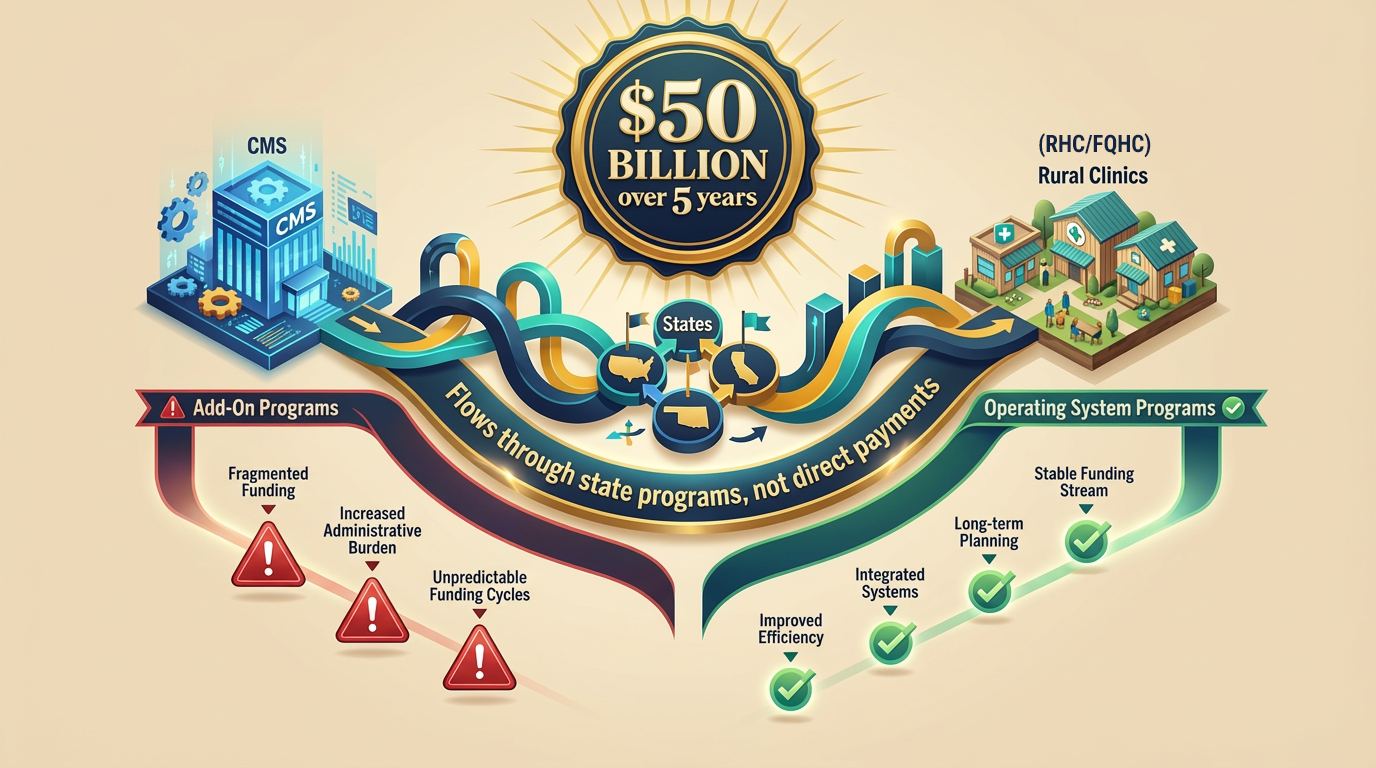
Awards Mean for Rural Clinics, FQHCs, and RHCs in 2026
On December 29, 2025, CMS announced $50 billion in Rural Health Transformation (RHT) awards across all 50 states. This is a five-year initiative with $10 billion available each year from 2026 through 2030.
Related FairPath Resources
If you lead a rural clinic, FQHC (Federally Qualified Health Center), RHC (Rural Health Clinic), or a multi-site practice serving rural communities, this is not “telehealth money.” It is a national modernization push with accountability attached, and it will accelerate two things at the same time:
- investment in new care models and technology
- scrutiny of whether programs can prove outcomes, compliance, and operational integrity
Quick answers (for leaders who need the summary)
What is RHT?
A CMS program funding state-led rural health transformation plans to strengthen access, workforce, infrastructure, technology, and value-based models.
How much is it?
$50B total, with $10B per year from 2026–2030.
How is it allocated?
50% is distributed equally across approved states and 50% is allocated based on factors defined in the Notice of Funding Opportunity (NOFO), including rurality, rural health system metrics, state policy actions, and projected impact.
What kinds of investments does CMS explicitly call out?
Modernizing facilities and technology, cybersecurity, interoperability, telehealth, remote patient monitoring, and digital tools, including workflow tools that reduce clinician burden.
Is CMS creating a dedicated office to oversee this?
Yes. CMS established the Office of Rural Health Transformation (ORHT) within the Center for Medicaid and CHIP Services to oversee implementation, provide technical assistance, and ensure oversight and accountability.
Why this matters operationally: the money will not land where most clinics expect
Most practices will not receive a direct check from CMS. The funding flows through state-directed transformation plans and will show up as state programs, partner initiatives, procurement opportunities, and reporting standards tied to continued funding. CMS is positioning this as a structured program with ongoing oversight and progress tracking.
The practical implication:
Your organization will be expected to run programs that can demonstrate measurable improvement and produce defensible evidence of what happened, when it happened, and why it was clinically necessary.
A reality check: remote care will expand, but “device deployment” is not the hard part
CMS explicitly calls out telehealth and remote patient monitoring as part of the modernization strategy.
That will push more rural organizations to expand:
-
RPM (Remote Patient Monitoring)
CCM (Chronic Care Management)
RTM (Remote Therapeutic Monitoring)
APCM (Advanced Primary Care Management)
But the programs that break under scale typically don’t fail because clinicians do not care. They fail because the operation can’t consistently prove:
- Eligibility and enrollment logic
- Required components and timing thresholds
- Care plan coherence (why the work mattered)
- Clear role accountability
- Clean claim logic (bundling, unit limits, supervision requirements)
- Audit-ready artifacts without scrambling at month-end
The hidden constraint: accountability rises faster than staffing
RHT is designed for outcomes and sustainability, not temporary pilots. CMS states that states will modernize infrastructure and technology, pursue value-based care models, and advance cross-provider partnerships. That is a recipe for reporting requirements and operational accountability becoming tighter over time.
For rural clinics, that creates a predictable fork in the road:
Path A: “Add-on programs”
- You bolt RPM or care management on top of already overloaded workflows.
- Documentation becomes a reconstruct-later problem.
- Claims become a risk surface (denials, recoupments, audits).
Path B: “Operating system programs”
- You standardize the workflow and artifacts first.
- Evidence is produced as care is delivered.
- Scaling volume does not scale chaos.
RHT funding will reward Path B because it is the only one that reliably survives oversight.
What the first-year funding looks like in the states we care about
HHS published the FY26 award amounts by state on December 29, 2025. It also states first-year awards average about $200M, ranging from $147M to $281M.
Examples:
- Florida: $209,938,195 ( HHS )
- Georgia: $218,862,170 ( HHS )
- Louisiana: $208,374,448 ( HHS )
- Texas: $281,319,361 ( HHS )
This matters because it signals urgency. States will move quickly to show early wins. Early wins drive procurement. Procurement drives technology decisions. Technology decisions lock in operating models for years.
What rural clinics should do next (a practical 2026 playbook)
-
Treat RHT as a governance and evidence problem, not a “telehealth project”
If you cannot easily produce a clean monthly evidence bundle, you are not ready to scale volume.
The 2026 PFS Final Rule practice guide can help you navigate that.
-
Standardize your “monthly evidence bundle” before you chase growth
At minimum, every month should reliably produce:
- Enrollment and eligibility rationale
- Consent and onboarding proof
- Device and/or time threshold proof
- Clinical review documentation linked to actionable data
- Claim readiness checks (bundling and unit logic)
With the Month-End Claim Guardrails quick guide , you can have a month-end operational template.
-
Build remote care on a stable foundation, not a volatile one
Payer policy volatility is increasing, and RPM economics are not guaranteed to remain stable. If your remote care plan depends on one code family, you are exposed.
APCM is designed as a predictable monthly care-management base. If you are building for sustainability in 2026, you should model it. We can help you calculate your APCM revenue and guide you through ACPM.
-
If you are an FQHC or RHC, do not copy-paste workflows from independent practices
FQHC/RHC billing and documentation logic has unique traps, especially when teams try to force new models into old wrapper assumptions.
Learn more about FQHC/RHC billing in 2026 .
-
Make compliance risk visible early, not after denials
When oversight tightens, you want early warning lights:
- Patients pacing below RPM thresholds
- Inconsistent documentation components
- Implausible time patterns
- Code interactions that trigger denials
Two fast tools that do not require PHI:
Frequently Asked Questions
Does RHT funding change Medicare RPM, CCM, RTM, or APCM billing rules?
No. RHT accelerates adoption and modernization, but billing rules still apply. The risk is scaling volume before your workflow and evidence are defensible.
Will my clinic receive RHT money directly from CMS?
Most clinics will experience RHT funding through state-directed programs, partnerships, and initiatives tied to state transformation plans rather than a direct CMS payment.
What kinds of tech investments are most defensible under RHT?
Technology that improves access while generating traceable evidence: clean enrollment logic, standardized care plans, automated threshold tracking, and claim guardrails. CMS explicitly calls out modernization work that includes cybersecurity, interoperability, telehealth, remote patient monitoring, and digital tools that reduce clinician burden.
What should a rural clinic do first if it wants to expand remote care safely?
Start by standardizing your monthly evidence bundle and claim integrity logic before you scale patient volume.
What is the fastest “no-PHI” way to understand your current risk posture?
Run a structured risk review against published oversight patterns and fix workflow gaps before expanding volume.
- Free RPM Fraud Risk & Optimization Report: https://fairpath.ai/lp1-oig-audit
Closing
RHT funding is a real investment, and it will move quickly. The clinics that benefit most will not be the ones that “try remote care.” They will be the ones that run remote care as an operating system: clinic-owned workflows, predictable evidence, and clean claim integrity.
If you want to pressure-test your readiness without using PHI:
- Get your RPM Fraud Risk & Optimization Report
- Run the Vendor P&L Analyzer
- Model APCM and hybrid revenue for 2026
External references
- CMS and HHS announcement with state award list and allocation rules: ( HHS )
- CMS press release (Dec 29, 2025): ( Centers for Medicare & Medicaid Services )
- CMS ORHT establishment press release: ( Centers for Medicare & Medicaid Services )
- CMS RHT program overview page: ( Centers for Medicare & Medicaid Services )