Prepare daily inputs
Calculate minutes logged, proximity to the next CPT threshold, and the frequency and recency of prior contact.

Revenue and capacity result
A smart daily queue helped one client move beyond manually auditing 100 patient charts a day and recover more than $80,000 in billable time during the first two months.

Business consequence
In Remote Patient Monitoring (RPM), Chronic Care Management (CCM), and Remote Therapeutic Monitoring (RTM), clinician time is both valuable and constrained. Teams had to scan dashboards, remember recent contacts, and decide subjectively who to call next.
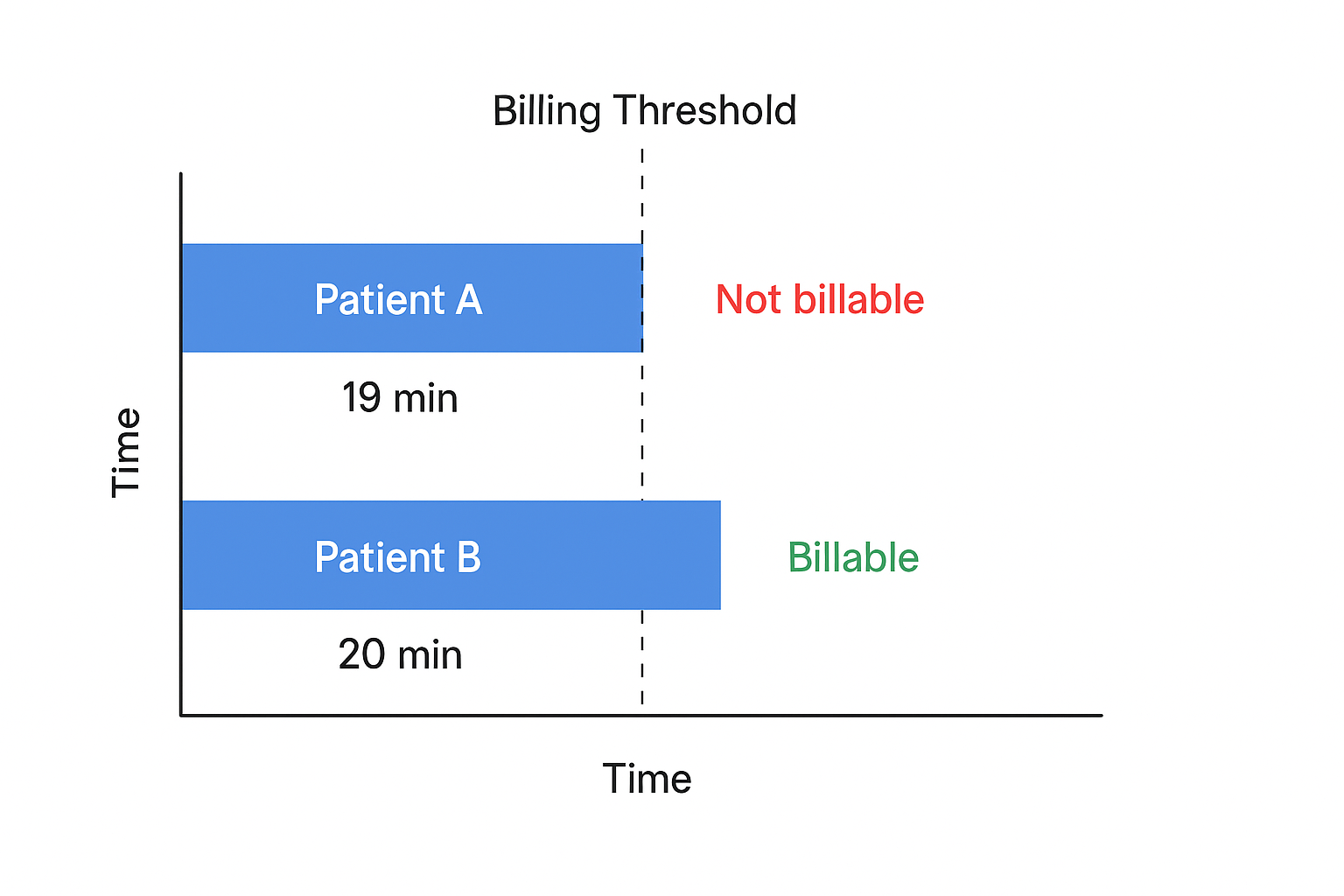
Time-based billing added another operating constraint. CPT 99457 requires 20 minutes of interactive care per patient per month, while CPT 99458 covers each additional 20-minute block. Nineteen minutes cannot meet the first threshold; time above 20 but below 40 does not meet the next one.
The challenge was to direct lower-urgency work efficiently without allowing billing considerations to displace patient safety. In practical terms: which patient should a clinician call today, who needs a reminder, and where can limited time still produce meaningful care?
The original case describes the manual process as inconsistent, difficult to scale, and cognitively exhausting. Smaller clinics faced the same problem without dedicated optimization staff, complex data teams, or large automation contracts.
Documented result
The original published case reports this result for one unnamed client; no customer quotation is presented.
Critical alerts, symptoms, and emergencies remained the responsibility of a separate safety-first triage algorithm. This queue addressed what happened after those priorities were handled.
Operating explanation
The system works with a queue of lower-urgency patients who are all eligible for meaningful care but compete for limited clinician time.
Technical reason to believe
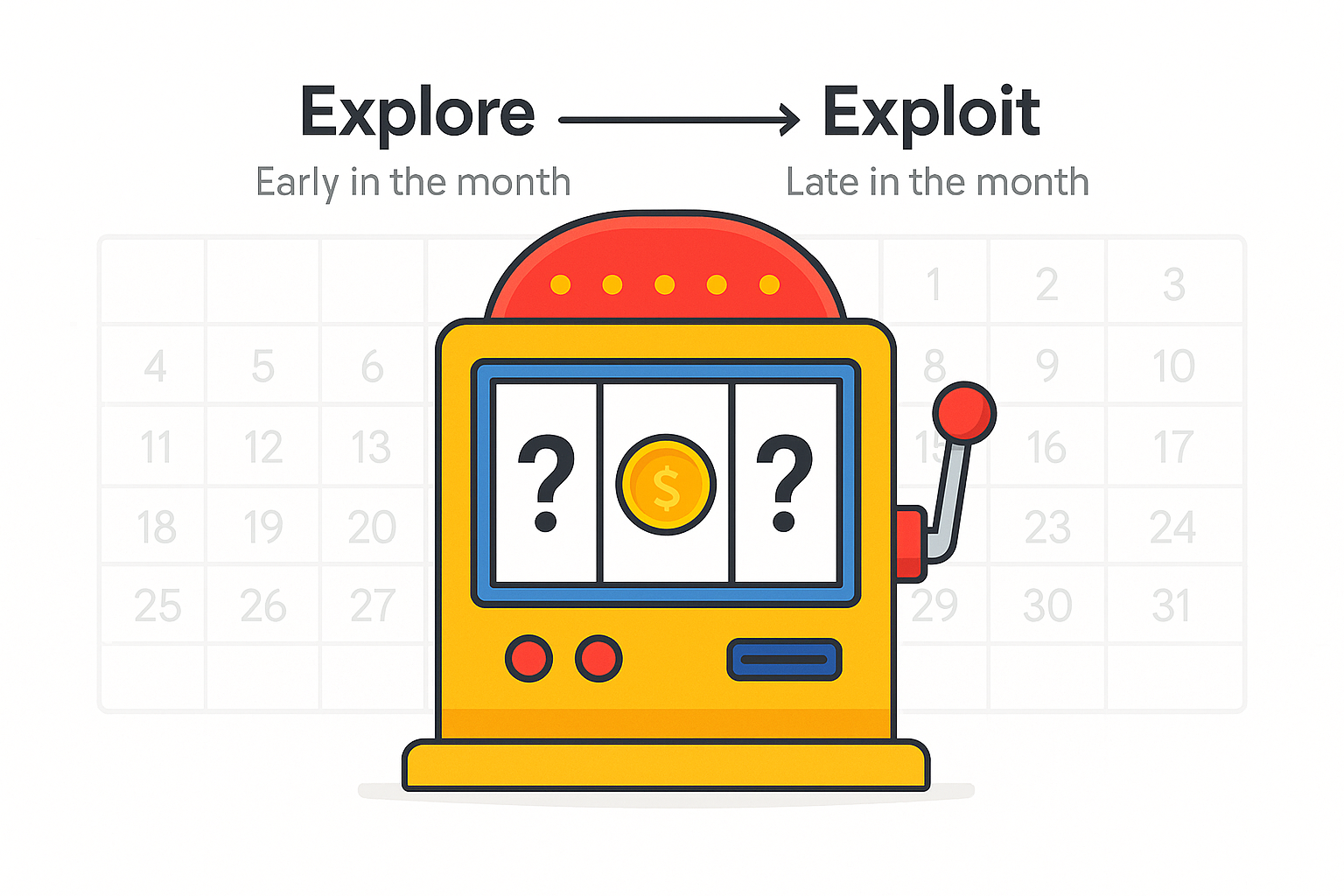
The prioritization model is a variation of the multi-armed bandit problem. Each patient is treated as an arm, and the modeled reward is completion of a billable CPT block. Patients are evaluated through defined operating inputs rather than unconstrained language generation.
The technical mechanism is secondary to the operating result: it supplies a repeatable way to decide who should receive lower-urgency time today.
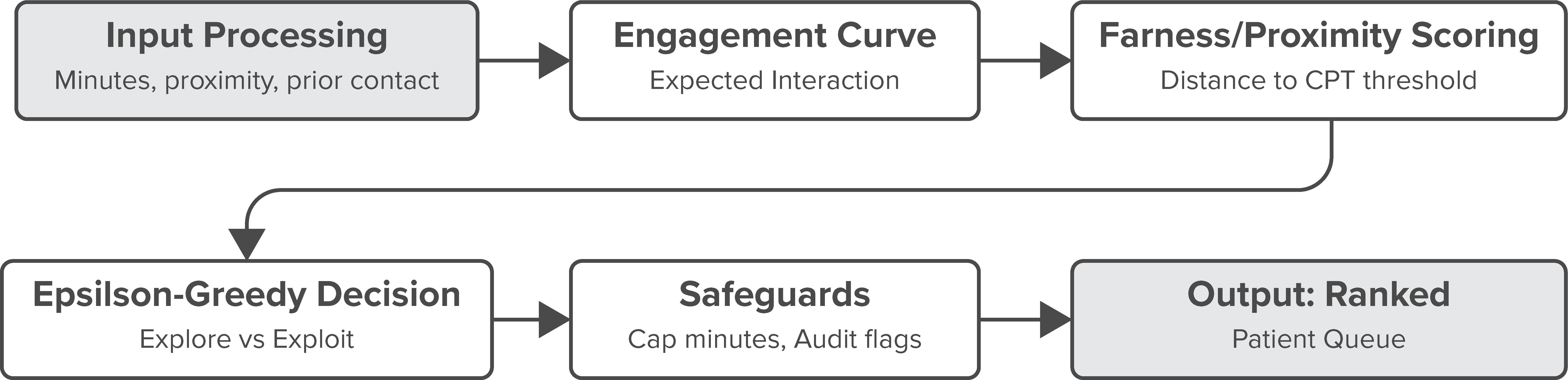
Calculate minutes logged, proximity to the next CPT threshold, and the frequency and recency of prior contact.
Use an expected engagement curve that assumes at least two minutes of interaction per day across a 30-day window, plus farness and proximity metrics around 20-minute blocks.
Use a day-weighted epsilon-greedy approach: sometimes explore; otherwise prioritize the strongest proximity-to-revenue signal. Epsilon varies through the month.
Cap time for any one patient, flag already over-served cases to reduce billing risk, and produce a ranked list aligned with CPT goals and available resources.
Useful for repetitive tasks, but brittle when the process changes and not tailored to clinical time management.
Can produce plausible language, but does not by itself supply billing-aware, inspectible decision rules.
Uses transparent rules, auditable inputs, explicit CPT thresholds, and inspectible safeguards.
The operating principle remains clinical: respect clinical judgment, remove decision noise, and balance time, care, and compliance. The model supports the lower-urgency queue; it does not replace safety triage or clinical decisions.

Talk to Us
Tell us what you are trying to accomplish and what is getting in the way.
Talk to Us